Mastering 3D Christmas House Ornament Sublimation: A Guide to Digital Design and Application
The holiday season brings a surge of creativity for crafters, small business owners, and DIY enthusiasts alike. Among the most popular projects during this time is the creation of custom ornaments, specifically those featuring intricate architectural themes like the 3D Christmas House Christmas Ornament. This trend has moved beyond simple flat images, evolving into complex, wrap-around designs that transform standard baubles into miniature winter villages. Understanding the nuances of Ornament Sublimation Design is crucial for anyone looking to produce high-quality, professional-grade decorations. Whether you are a hobbyist creating gifts for family or an educator teaching digital design principles, grasping the workflow from Instant Digital Download PNG to the final pressed product ensures success.
The core of this craft lies in the digital asset itself. When sourcing materials, one often encounters terms like Ornament Wrap PNG or Christmas House Christmas background. These files are not merely pictures; they are engineered templates designed to fit specific physical dimensions. A typical Christmas House Christmas png intended for sublimation is crafted with precise measurements, often around 5 inches by 5 inches at 300 DPI, to ensure crisp lines and vibrant colors when transferred to polyester-coated surfaces. The distinction between a standard image and a dedicated Christmas House Christmas Ornament wrap is significant. The latter accounts for the curvature of the ornament, ensuring that when the design is wrapped around the sphere, the edges meet seamlessly without distorting the primary imagery of the house or the surrounding scenery.
The Mechanics of 3D Ornament Wraps and Seamless Patterns
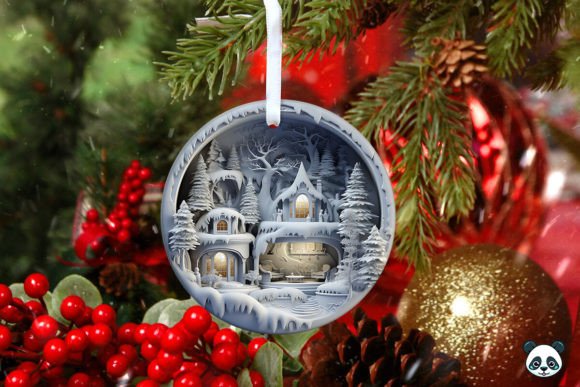
To achieve a truly immersive look, designers utilize seamless pattern techniques alongside focal point illustrations. In the context of a 3D Christmas House Christmas design, the front of the ornament might feature a detailed watercolor-style cottage, while the sides and back utilize a repeating Christmas House Christmas seamless pattern. This approach creates a cohesive aesthetic where the viewer feels surrounded by the theme. The term 3D design in this niche often refers to the visual depth created through shading, layering, and perspective within the 2D file, which translates into a three-dimensional appearance once applied to the spherical object.
Working with a 3D Ornament wrap requires an understanding of how ink behaves during the sublimation process. Unlike printing on paper, sublimation involves turning solid dye into gas under heat and pressure, allowing it to permeate the polymer coating of the ornament. Consequently, the 3d Ornament Wrap file must be mirrored horizontally before printing. If this step is skipped, any text or directional elements within the Christmas House Christmas wrap will appear backward on the final product. Furthermore, the 3d Ornament template usually includes bleed areas—extra space beyond the cut line—to prevent white edges from showing if the alignment shifts slightly during the pressing phase.
The versatility of these designs allows for various stylistic interpretations. For instance, a Christmas House Christmas watercolor style offers a soft, artistic feel that appeals to traditionalists, while a bold, graphic sublimation Design might target a more modern audience. Regardless of the style, the underlying technical requirement remains the same: the file must be high resolution. A low-resolution Digital Download will result in pixelation, ruining the illusion of a high-end 3D Christmas House Christmas Ornament. Professionals always verify that their source files, such as the 15 Oz Ornament Template equivalents adapted for smaller spheres, maintain at least 300 dots per inch (DPI) to guarantee sharpness.
Practical Workflows for Creators and Business Owners
For business owners and creators, the efficiency of the production workflow is paramount. Utilizing an Instant Digital Download model allows for immediate access to assets, eliminating shipping delays associated with physical stencils or pre-printed transfers. Upon purchasing a ZIP file containing the necessary PNG File, the creator can immediately begin the preparation process. This typically involves opening the file in design software, mirroring the image, and sizing it to match the specific sublimation blank being used. It is important to note that while many templates are standardized, variations exist. Some ornaments require a Christmas House Christmas skinny Ornament layout, which is taller and narrower, whereas others follow a classic spherical ratio.
The application process itself demands precision. After printing the Ornament wrap sublimation design onto specialized sublimation paper using eco-solvent or sublimation inks, the creator wraps the paper tightly around the ornament blank. Securing the paper with heat-resistant tape is critical to prevent "ghosting," where movement during the press causes blurred lines. The assembly is then placed into a convection oven or a specific ornament press. Temperature and time settings vary by manufacturer, but the principle of the 3d Ornament sublimation process remains consistent: heat activates the dye, and pressure ensures full contact between the paper and the curved surface.
Educators and researchers studying digital manufacturing trends often highlight the accessibility of this technology. The barrier to entry for creating Sublimation Designs has lowered significantly, thanks to the availability of pre-made Ornament wrap template files. This democratization allows individuals without advanced illustration skills to produce professional results by leveraging the work of talented digital artists who specialize in Christmas House Christmas background compositions. However, it also necessitates a baseline of technical knowledge regarding color profiles (CMYK vs. RGB), printer calibration, and heat press mechanics to fully realize the potential of the 3D background effects embedded in the design.
Design Considerations and Aesthetic Trends
When selecting a design, one must consider the end-user's environment. A Christmas House Christmas motif is timeless, but the execution can vary widely. Some users prefer a nostalgic, vintage look achieved through distressed textures and muted tones, while others opt for bright, saturated colors that pop against a green Christmas tree. The concept of a 3D Ornament wrap facilitates these variations by providing a canvas that covers the entire object. This full coverage is particularly effective for themes like winter villages, where extending the snow or sky from the front to the back enhances the realism.
Moreover, the integration of seamless pattern elements allows for customization. A creator might take a base Christmas House Christmas png and overlay additional graphics, such as family names or dates, using the negative space provided in the background. This flexibility makes the Ornament Wrap PNG format highly valuable for personalized gifts. The ability to manipulate these layers without losing the integrity of the original 3D design is a key advantage of working with layered PSDs or high-quality transparent PNGs.
It is also worth noting the material compatibility. Not all ornaments are suitable for sublimation. The blanks must have a polyester coating or be made entirely of polymer. Ceramic, glass, or untreated metal ornaments will not accept the dye transfer required for a 3d Ornament design. Ensuring the correct substrate is used is just as important as having the right Sublimation Designs. This consideration is often overlooked by beginners who assume any shiny surface will work, leading to frustration when the Christmas House Christmas wrap fails to adhere or appears washed out.
Maximizing Quality and Longevity
The longevity of a 3D Christmas House Christmas Ornament depends heavily on the quality of the initial digital file and the precision of the pressing process. High-quality Digital Download files are optimized to prevent banding—a visible striping effect that can occur in gradients, such as the sky in a Christmas House Christmas watercolor scene. To mitigate this, designers often employ dithering techniques within the 3D background areas. For the end user, proper care instructions should be provided. While sublimated images are generally durable and resistant to fading, avoiding abrasive cleaners and extreme temperature fluctuations will preserve the vibrancy of the Christmas House Christmas Ornament wrap for years.
In the realm of commercial sales, offering a variety of styles within the Christmas House Christmas category can broaden market appeal. A shop might offer a collection that includes a classic red barn, a Victorian mansion, and a whimsical gingerbread house, all utilizing the same 15 Oz Ornament Template logic but scaled for smaller ornaments. This consistency in production workflow allows for batch processing, increasing efficiency during the busy holiday rush. The use of standardized Ornament wrap sublimation files ensures that every unit produced meets the same quality standards, reinforcing brand reputation.
Ultimately, the fusion of artistic vision and technical execution defines the success of these projects. Whether utilizing a pre-made 3d Ornament Wrap or creating a custom seamless pattern from scratch, the goal is to evoke the warmth and joy of the season. The 3D Christmas House Christmas theme resonates deeply because it taps into universal memories of home and celebration. By mastering the tools of sublimation Design and understanding the intricacies of Ornament wrap template usage, creators can deliver tangible pieces of art that bring delight to homes around the world. The journey from a simple PNG File to a cherished heirloom is a testament to the power of modern digital crafting technologies.
As the industry continues to evolve, we can expect to see even more sophisticated 3D design elements integrated into these templates, perhaps incorporating augmented reality markers or more complex multi-layer wrapping techniques. However, the fundamental principles of high-resolution imaging, proper color management, and precise heat application will remain the cornerstone of producing exceptional Christmas House Christmas png based ornaments. For now, the focus remains on perfecting the craft, ensuring that every Christmas House Christmas background tells a story and every 3D Ornament serves as a beacon of holiday spirit.